Fair Wagering And UFC Betting Integrity
 Available in US
I was watching a prelim fight in late 2023 when the line moved so sharply in the final hour that it set off alarms across every sportsbook simultaneously. The favourite went from -250 to -160 on no public information. No injury update, no weigh-in controversy, nothing. Just money, pouring in on the underdog from accounts that had never previously bet on MMA. That fight was eventually pulled from the card. It was one of the clearest demonstrations of how betting integrity monitoring works in real time — and why it matters to every punter who places a UFC bet.
The MMA betting handle reached $10.3 billion globally in 2024, and a market that size attracts attention from everyone — legitimate bettors, operators, regulators, and, inevitably, people looking to manipulate outcomes. UFC has invested heavily in monitoring systems, but the history of integrity issues in the sport is more complicated than the organisation’s public statements suggest.
IC360 Systems: Tracking UFC Betting Irregularities
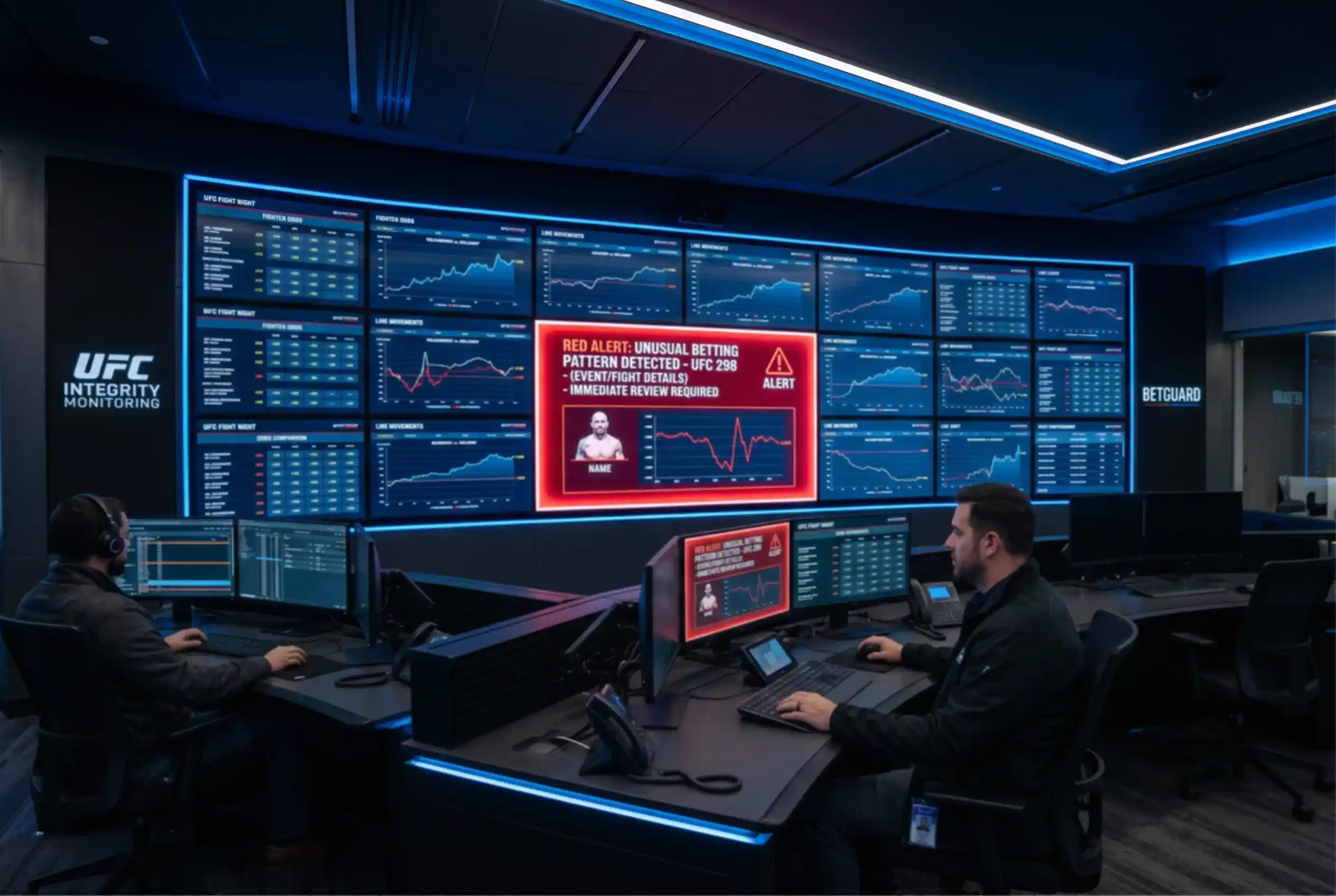
UFC has worked with IC360 — formerly known as U.S. Integrity — since January 2023 to monitor wagering activity on every single event. The partnership was the organisation’s direct response to a series of embarrassing integrity incidents that threatened to undermine the credibility of UFC as a betting product.
The UFC’s official position is straightforward: the organisation works with “an independent betting integrity service to monitor wagering activity on our events,” with IC360 conducting “a thorough review of the facts” whenever anomalies are detected. In practice, the system works by aggregating odds movement data from sportsbooks worldwide, flagging fights where the betting patterns deviate significantly from expected models.
When IC360 detects unusual activity — a sudden one-directional line movement, concentrated betting from new or previously dormant accounts, or wagering volumes that exceed the fight’s profile — it alerts the UFC. The organisation then has several options: investigate quietly while the fight proceeds, contact the fighters or their camps for explanations, or, in extreme cases, pull the fight from the card entirely.
The system is not foolproof. Monitoring catches large, clumsy manipulation attempts — the kind where significant money moves the line in obvious ways. Smaller, more sophisticated manipulation involving offshore accounts, intermediaries, or fighters who subtly underperform without making it obvious is harder to detect. Richard Schuetz, a veteran of multiple US gaming commissions, has noted that licensed operators have a financial duty to protect integrity because regulators expect their share of the revenue. The incentive structure works, but it works best against the most obvious forms of manipulation.
Notable Cases: Dulgarian, Krause, and Pulled Fights
The integrity issues that prompted UFC’s partnership with IC360 were not abstract concerns — they were specific, public, and damaging.
The James Krause case was the most high-profile. Krause, a UFC fighter and coach, was accused of involvement in suspicious wagering patterns tied to fights involving his gym’s fighters. The case triggered an FBI investigation, a lifetime ban from the UFC for Krause, and a wave of policy changes across the sport. It was the moment that forced the promotion to acknowledge that integrity monitoring was not optional — it was essential for the sport’s survival as a credible betting product.
Shayilan Nuerdanbieke — often referred to by his previous name in media coverage — was involved in another high-profile case where suspicious betting patterns were flagged before the fight took place. The case highlighted how sportsbook data can serve as an early warning system, catching potential manipulation before it reaches the cage.
Dana White himself has been characteristically blunt about these situations. After a fight was pulled from UFC 324 due to integrity concerns, he stated that when the gaming integrity service called, his response was immediate and non-negotiable. That willingness to cancel fights at the last minute — absorbing the financial and logistical cost — demonstrates how seriously the organisation now takes wagering-related red flags.
The pattern across these cases is consistent: detection happens at the sportsbook level, through unusual line movement or account-level betting patterns. The integrity service aggregates this data and escalates. The UFC acts — sometimes publicly, sometimes quietly. What the public sees is the tip of the iceberg; the number of fights where quiet warnings were issued behind the scenes is likely considerably larger.
What Integrity Flags Mean for Your Bets
If a fight is pulled from a card due to integrity concerns, your bets are voided and your stakes returned. This is standard practice across all UKGC-licensed sportsbooks. You lose nothing financially, but you do lose the opportunity — any analysis you conducted on that fight is wasted time.
More practically, understanding integrity dynamics can inform your betting approach. Sudden, unexplained line movements in the final hours before a fight should make you cautious. If a line moves 30 points or more without a public explanation, something is happening that the market knows and you do not. It might be legitimate — a training injury leaked to insiders, a weight-cutting problem — or it might be something more concerning. Either way, the smart response is to step back rather than chase the new price.
The broader picture is reassuring for UK punters. The combination of IC360 monitoring, UKGC regulatory oversight, and the financial incentives of licensed operators creates multiple layers of protection. No system eliminates manipulation entirely, but the infrastructure in place for UFC is more robust than for virtually any other combat sport — and significantly more developed than what existed even three years ago.
One often-overlooked angle: integrity monitoring also protects the market from false alarms. Unusual line movements happen regularly for innocent reasons — a respected tipster publishing a pick, a single large bet from a high-roller, or news about a fighter’s training camp filtering through social media. IC360’s role is to distinguish between suspicious activity and legitimate market forces, which prevents sportsbooks from overreacting and pulling fights unnecessarily. That filtering function benefits bettors by keeping cards intact and markets stable.
For anyone worried about the integrity of the fights they are betting on, the practical advice is simple: bet through UKGC-licensed platforms, pay attention to sharp line movements you cannot explain, and trust that the monitoring system — while imperfect — catches the most egregious attempts at manipulation before they reach the cage.
What is the UFC’s relationship with betting integrity services?
UFC has partnered with IC360, formerly known as U.S. Integrity, since January 2023. IC360 monitors wagering activity on every UFC event, flagging unusual betting patterns for investigation. The partnership was established after several high-profile integrity incidents in the sport.
Has a UFC fight ever been cancelled due to suspicious betting activity?
Yes. Several fights have been pulled from UFC cards after integrity monitoring flagged suspicious wagering patterns. Dana White has confirmed that the organisation acts on alerts from its integrity partner, including cancelling fights at the last minute when concerns are serious enough.
Can individual bettors be investigated for suspicious wagering?
Yes. UKGC-licensed sportsbooks monitor account-level betting activity and can flag suspicious patterns to regulators and integrity services. If your betting behaviour triggers an alert — such as consistently large bets on obscure UFC outcomes — the sportsbook may investigate, restrict your account, or report the activity to the relevant authorities.
Published by the ufc Betting Website team.