Data-Driven Edge Using UFC Fighter Stats
 Available in US
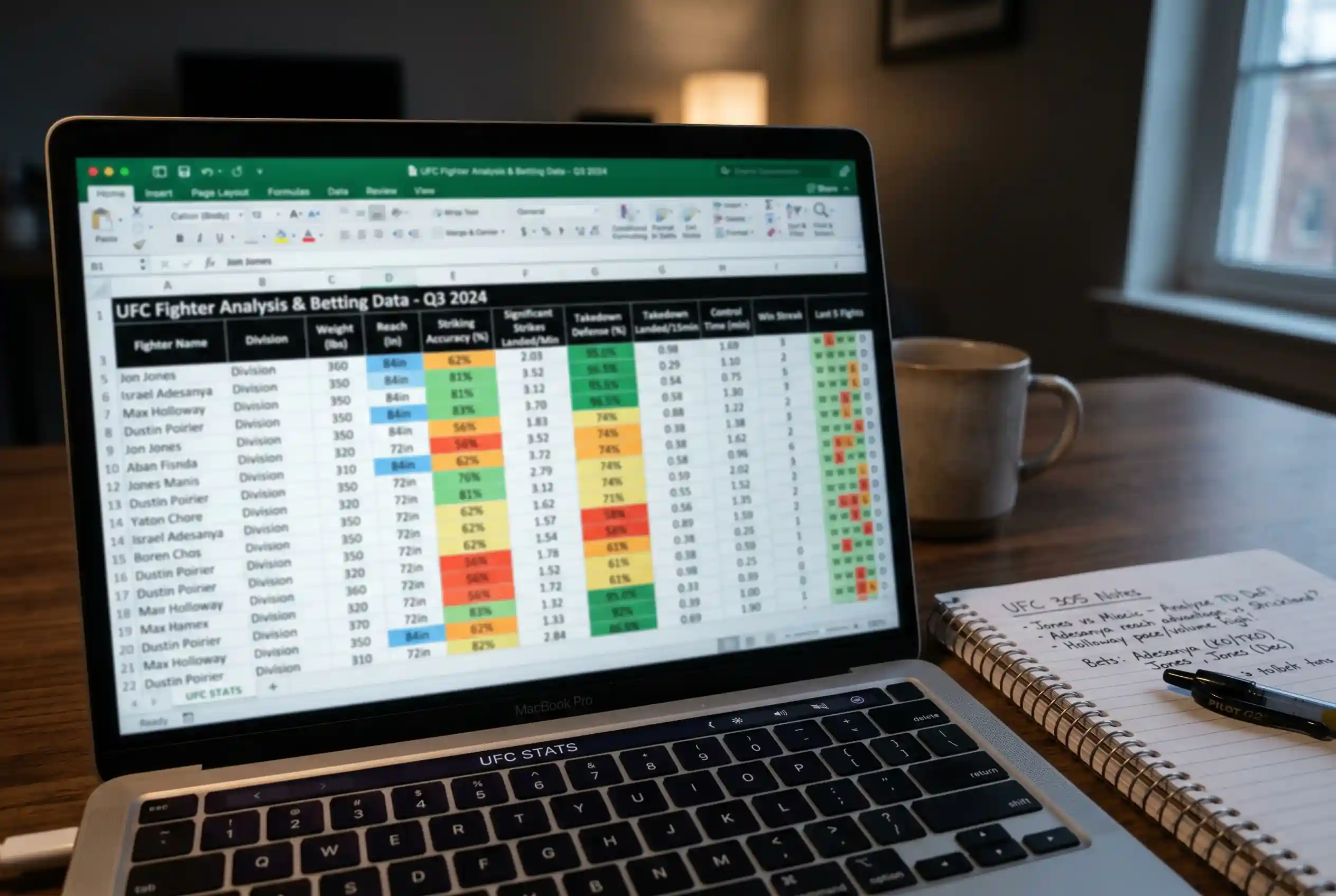
Early in my betting career, I built a spreadsheet with every UFC fighter statistic I could find — striking accuracy, takedown defence, reach, height, age, fight frequency, rounds fought, average fight time, the lot. It was a monster of a document, and it was almost entirely useless. Not because the data was wrong, but because I was treating every metric equally. The breakthrough came when I realised that three statistics explain more about fight outcomes than the other twenty combined.
The UFC runs 42-43 events annually, generating thousands of data points across hundreds of fights. The challenge is not finding statistics — the UFC publishes detailed stats on its own website — but knowing which numbers carry predictive weight and which are noise. After years of tracking my own results against statistical models, the picture is clearer than most analysts admit.
Core Metrics: Striking, Takedown Defence, and Reach
Striking accuracy measures the percentage of a fighter’s strikes that land on their opponent. It sounds straightforward, but its predictive value is nuanced. High striking accuracy correlates with winning fights, but the correlation is weaker than you might expect because accuracy can be inflated by fighting cautious opponents or deflated by fighting elite defensive fighters. Where accuracy becomes genuinely useful is in relative terms: comparing Fighter A’s accuracy against the defensive metrics of Fighter B, rather than looking at the raw number in isolation.
Takedown defence — the percentage of takedown attempts a fighter successfully stuffs — is arguably the most undervalued statistic in UFC betting. A fighter with 85%+ takedown defence against a wrestler-heavy opponent is sending a strong signal: the fight is likely to stay standing, which changes the method of victory calculus, the round-total dynamics, and the overall pace. When I see a striker with elite takedown defence facing a wrestler whose primary path to victory is ground control, the striker’s moneyline is almost always worth a closer look.
Reach advantage — the difference in arm length between two fighters — matters more for knockouts than for overall win probability. A significant reach advantage (5+ inches) gives a fighter the ability to land clean shots from range while avoiding return fire. This correlates with knockout finishes and with fights ending inside the distance. Reach does not predict who wins as reliably as it predicts how the fight unfolds, which makes it more useful for method of victory and round betting than for the moneyline.
Where to Find Reliable UFC Fighter Statistics
The UFC’s official stats portal publishes per-fighter and per-fight statistics for every bout in the promotion’s history. Significant strikes landed and absorbed, takedown accuracy and defence, control time, knockdowns — the core metrics are all there, updated within days of each event.
Third-party analytics sites supplement the official data with advanced metrics: strike differential (strikes landed minus strikes absorbed per minute), control time percentage, and composite scores that weight multiple statistics into a single predictive index. These advanced metrics are more useful than raw numbers because they normalise for fight length, opponent quality, and stylistic context.
The global UFC market is valued at $1.74 billion in 2026, and the analytical infrastructure supporting that market has matured accordingly. Where five years ago you needed to compile your own spreadsheets from fight-by-fight data, today there are multiple platforms offering pre-built dashboards, historical comparisons, and matchup tools. The barrier to entry for data-driven UFC betting has dropped significantly — what matters now is not access to data, but the quality of your interpretation.
Translating Fighter Statistics Into Betting Decisions
Raw statistics do not make bets — interpretations do. The process I use for every fight starts with the same question: what does the data tell me about how this fight will unfold, and does the sportsbook’s price reflect that story?
Start with the style matchup. Is this striker vs. striker, grappler vs. grappler, or a mixed-style contest? The answer determines which statistics to prioritise. In a striker-vs-striker fight, striking accuracy and significant strikes absorbed per minute become the lead indicators. In a grappler-vs-striker matchup, takedown defence and control time take precedence.
Layer in the opponent-specific context. A fighter with 80% takedown defence overall might have faced only two genuine wrestlers in their UFC career, making the sample unreliable. Conversely, a fighter with 65% takedown defence whose last three opponents were all high-level wrestlers has proven their ability against the relevant test. Context transforms a number from a statistic into evidence.
Finally, check for trends rather than averages. A fighter whose striking accuracy has declined across their last three fights may be slowing down, adjusting to new coaching, or facing tougher competition. A fighter whose takedown defence has improved sharply might have added a wrestling coach. Trends capture trajectory; averages capture history. For betting purposes, trajectory is more valuable because the market tends to anchor on historical averages.
Stats That Mislead: What to Ignore and Why
Win-loss record is the most overvalued statistic in UFC betting. A record of 15-3 tells you that a fighter has been successful, but it says nothing about who they beat, where they fought, or whether their recent form matches their career trajectory. Sportsbooks bake the record into their pricing, which means you gain no edge by knowing something that everyone can see on the fight poster.
Age is another frequently misinterpreted metric. A 37-year-old heavyweight with knockout power and fight-IQ experience is a fundamentally different proposition from a 37-year-old lightweight whose game depends on speed and cardio. Age-related decline varies enormously by weight class, style, and training history. Using a simple age cutoff — “over 35 is a fade” — costs you money because it ignores the specifics that determine whether age is a genuine factor in a given matchup.
Total fights landed is misleading without context. A fighter who landed 150 significant strikes in their last bout might have done so over five rounds at a modest pace, while a fighter who landed 40 in one round delivered devastating volume that ended the fight. Per-minute rates, not per-fight totals, are the appropriate measure. Similarly, “knockout rate” can be inflated by early-career regional bouts against inferior competition. UFC-only knockout rate against ranked opposition is a far more honest indicator.
The common thread: statistics without context are trivia. Statistics with context are tools. Every number you consider should be filtered through the matchup, the division, the trajectory, and the sportsbook’s implied probability before it informs a bet.
Which UFC stat is the best predictor of fight outcomes?
No single statistic reliably predicts outcomes in isolation. Takedown defence is the most undervalued metric because it determines whether a fight stays standing or goes to the ground, which cascades into method of victory and round-total outcomes. Striking accuracy and reach matter but are most useful in combination with opponent-specific context.
How do I find UFC fighter stats before placing a bet?
The UFC’s official stats portal publishes per-fighter statistics including striking accuracy, takedown defence, significant strikes, and control time. Third-party analytics sites offer advanced metrics, historical comparisons, and matchup tools that add context to the raw numbers.
Does reach advantage actually affect UFC odds?
Reach advantage correlates more with how a fight ends than with who wins. A significant reach advantage increases the probability of a knockout finish and can shorten the expected fight duration. Sportsbooks factor reach into their models, but the adjustment is often imprecise, creating potential value in method of victory and round-total markets.
Published by the ufc Betting Website team.