Securing Profits With UFC Betting Cash Out
 Available in US
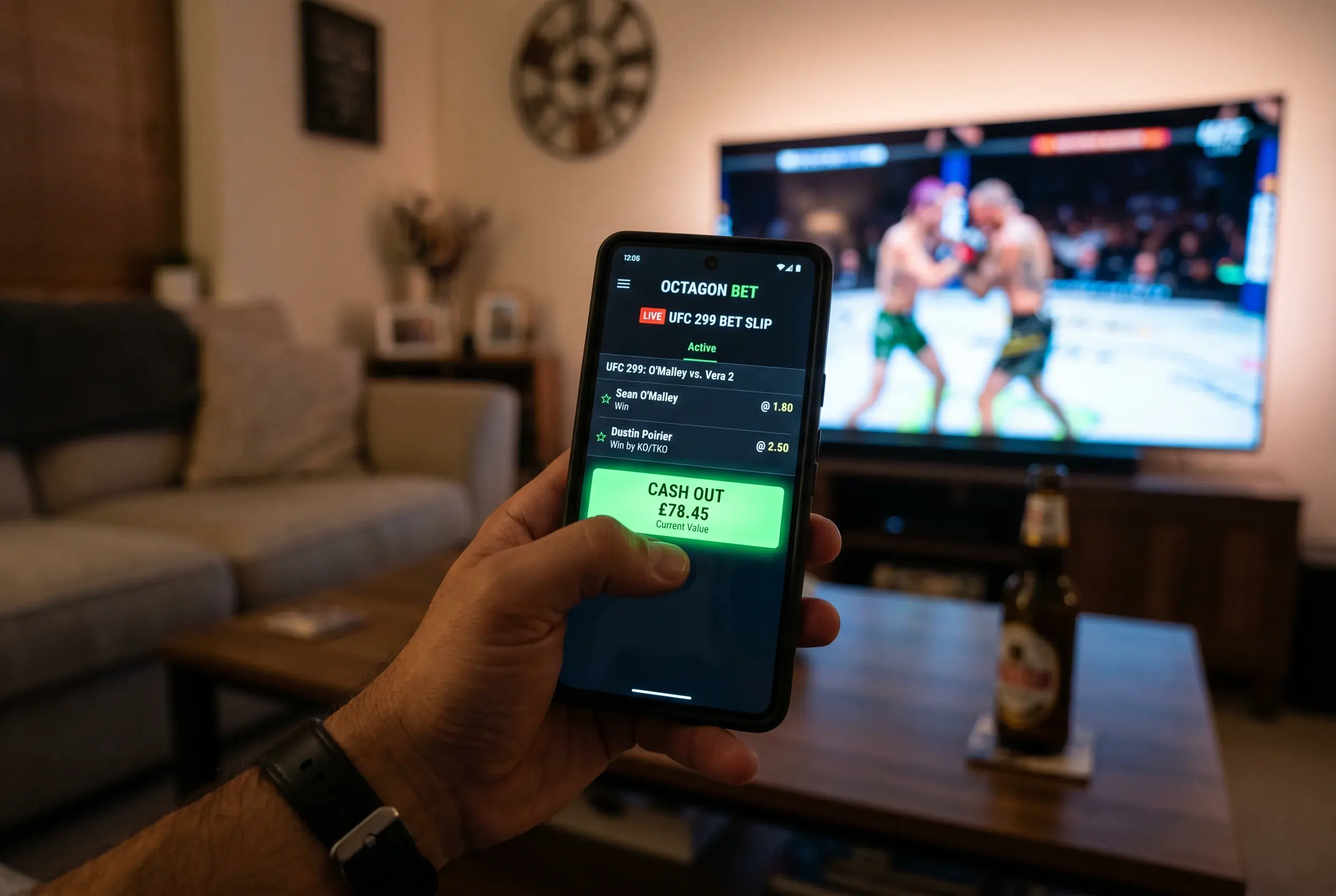
I once cashed out a UFC bet worth £240 in profit with 90 seconds left in the final round. My fighter was ahead on the scorecards, cruising to a decision – and then his opponent landed a clean right hand that wobbled him badly. I hit cash out before the next exchange. Forty-five seconds later, my fighter recovered and won the decision. I left £80 of potential profit on the table, and I would make the same decision again tomorrow. Cash out is not about maximising every bet – it is about managing risk in a sport where everything can change in a single exchange.
Cash out has become one of the most-used features at UK sportsbooks, and UFC’s fast-paced format makes it particularly relevant. In-play betting captured 62.35% of global online betting revenue in 2025, and cash out is the tool that lets you actively manage positions within that in-play environment rather than passively waiting for the final result.
Calculating Early Payouts During UFC Bouts
The cash out value you see on your bet slip is not arbitrary – it is a real-time calculation based on the current odds, your original stake, and the sportsbook’s margin. In simple terms, the platform is offering to buy your bet back at a price that reflects the current probability of your selection winning, minus a small margin for the bookmaker.
If you backed Fighter A at 2.50 with a £20 stake (potential return £50), and Fighter A wins the first round convincingly, their live odds might shorten to 1.40. The cash out value will be somewhere around £28-32 – reflecting the improved probability of your bet winning but discounted by the sportsbook’s live margin. That £28-32 is guaranteed money if you take it; the remaining £18-22 of potential profit requires Fighter A to actually win the fight.
The calculation shifts rapidly during UFC fights. A knockdown can swing the cash out value by 30-50% in seconds. A clear round on the scorecards produces a steadier, more gradual increase. Submission attempts create wild swings as the probability of a finish surges and then recedes. Understanding this volatility is essential: the cash out button shows you a snapshot of a constantly moving number, and what you see at the start of a round may look very different by the end of it.
One detail most punters miss: the sportsbook’s margin on cash out is typically higher than its margin on the original bet. The convenience of closing your position mid-fight comes at a cost, and that cost is embedded in the gap between the fair mathematical value of your bet and the cash out amount offered. It is a trade worth making in many situations, but it is never free.
Full vs. Partial Cash Out: Choosing the Right Option
Full cash out settles your entire bet at the offered value. You take the money, the bet closes, and the final result no longer matters. This is the cleanest option when your risk assessment has changed fundamentally – your fighter looks hurt, the judges’ scoring seems off, or you have simply seen enough to take profit and walk away.
Partial cash out lets you lock in a portion of your position while leaving the rest to run. If the full cash out is £35, you might take £20 now and leave £15 worth of exposure riding on the result. This is the more sophisticated approach and suits situations where your conviction has weakened but not disappeared – your fighter lost a round but still looks competitive, or the fight is closer than expected but not lost.
Not all UK sportsbooks offer partial cash out on UFC markets, and among those that do, the minimum partial amount varies. Flutter Entertainment, whose brands dominate the UK market with parent company revenue of $15.91 billion in 2025, generally offers the most flexible cash out options including partial settlement on most pre-fight and in-play UFC bets. Smaller operators may limit cash out to full settlement only, which reduces your strategic options mid-fight.
Cash Out Availability Across UK UFC Sportsbooks
Cash out availability is not universal, and the differences between platforms can affect your betting strategy. The larger sportsbooks – bet365, Paddy Power, and others in the Flutter and Entain portfolios – offer cash out on the majority of pre-fight UFC bets and extend it into live markets during the fight. The feature typically works on moneyline bets, accumulators, and some method-of-victory markets.
Smaller or newer sportsbooks may restrict cash out to pre-fight bets only, or may not offer it at all on UFC markets. Prop bets and bet builder combinations are less likely to have cash out available because the pricing complexity of multi-outcome bets makes real-time recalculation more challenging for the sportsbook’s systems.
One practical tip: if cash out is important to your approach, check whether your preferred sportsbook offers it on UFC markets before placing the bet. Some platforms advertise cash out as a general feature but exclude it from specific sports or market types. Discovering that cash out is unavailable on your UFC accumulator after the first two legs have landed is not a pleasant surprise.
Strategic Use of Cash Out in UFC Betting
Cash out is a tool, not a strategy. Used well, it protects profits and limits losses. Used poorly, it becomes a mechanism for locking in suboptimal results driven by anxiety rather than analysis.
The situations where cash out adds genuine value are specific. If your pre-fight analysis assumed Fighter A would dominate on the ground, and the first round revealed that the opponent’s takedown defence is far better than expected, cashing out reflects updated information – your thesis was wrong, and the smart move is to exit. If your fighter suffers a visible injury – a cut above the eye, a limp after a leg kick – that changes the probability landscape in ways the cash out value may not yet fully reflect, and taking the money protects against a finish that the sportsbook has not yet priced in.
Where cash out destroys value is in routine anxiety. Your fighter loses a close round, and you panic and cash out a bet that still has positive expected value. Over time, this pattern systematically locks in smaller profits than the underlying bets would have generated. The remedy is simple but difficult: only cash out when your analysis of the fight has changed, not when your emotional state has.
For accumulators, cash out becomes relevant when your first few legs have landed and you want to guarantee a return. A four-leg parlay with three legs won has significant value, and cashing out locks in a guaranteed profit regardless of the final leg’s result. This is one of the most rational uses of the feature – you are converting a high-variance position into a certain outcome, which is sound risk management for any live betting approach.
Do all UK sportsbooks offer cash out on UFC bets?
No. Most major UK sportsbooks offer cash out on pre-fight UFC moneyline bets and accumulators, but availability varies for in-play markets, prop bets, and bet builders. Smaller platforms may not offer cash out on UFC markets at all. Check your sportsbook’s terms before placing a bet if cash out is important to your strategy.
Can I partially cash out a UFC accumulator?
Some UK sportsbooks offer partial cash out on accumulators, allowing you to lock in a portion of your position while leaving the rest to run. Availability depends on the platform and the specific markets included in your accumulator. Larger sportsbooks with more advanced technology are more likely to support partial cash out.
Why does the cash out value drop between UFC rounds?
Cash out values fluctuate based on live odds, which reflect the current probability of each outcome. If your fighter loses a round, their live odds lengthen, and the cash out value drops accordingly. The sportsbook also applies a margin to the cash out price, which can amplify the decrease compared to the raw odds movement.
Written by the editors at ufc Betting Website.