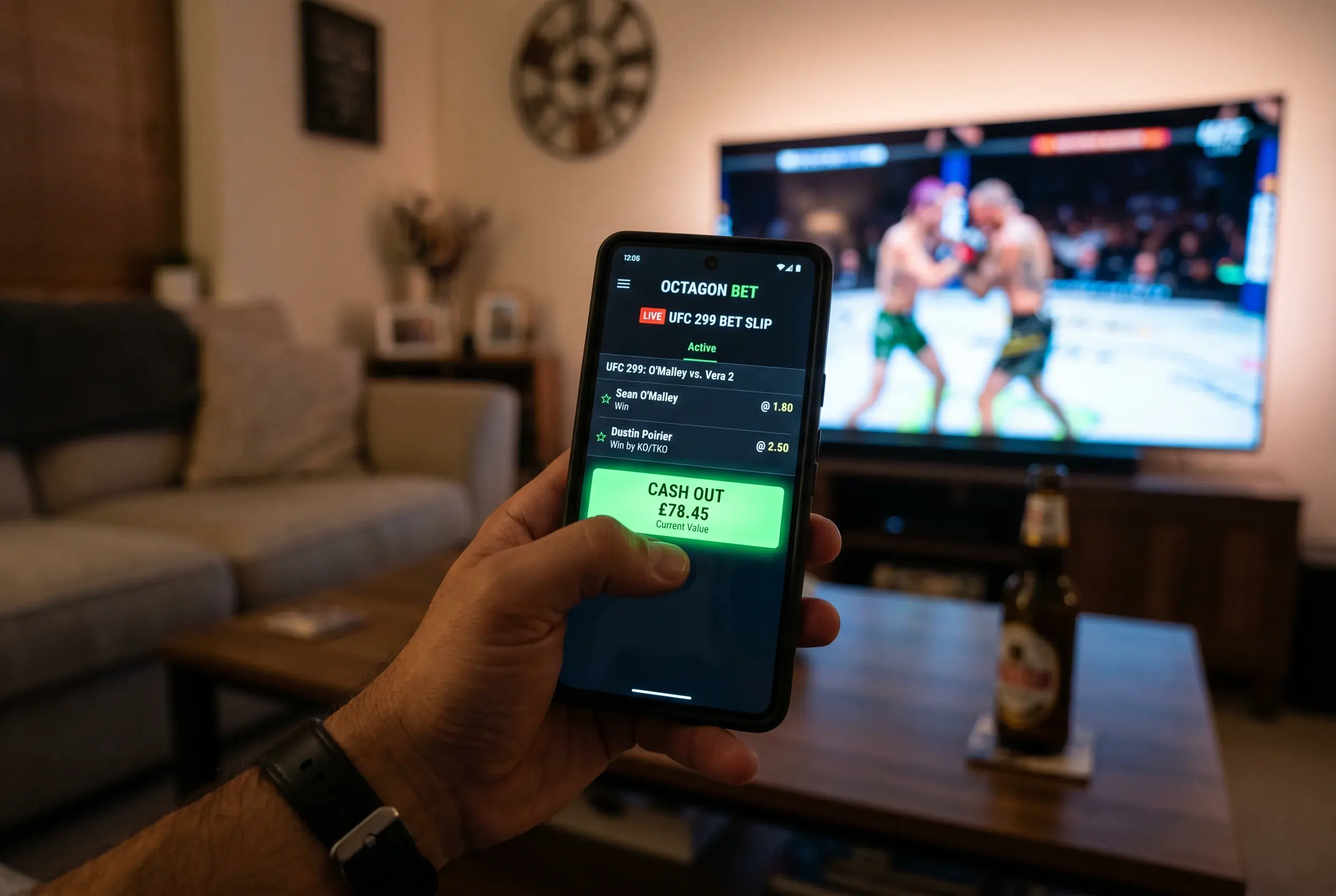
Finding UK Value With UFC Betting Odds
 Available in US

I placed my first UFC bet in 2017, and I got the odds completely wrong — not the pick itself, but what the numbers actually meant. I backed a -250 favourite thinking I was getting 2.5x my stake. The payout on a win taught me a painful and unforgettable maths lesson. Nine years later, I still see punters making the same mistake every fight night, and it costs them far more than one bad slip.
UFC betting odds are not decoration. They are compressed information — a sportsbook’s best estimate of each fighter’s probability of winning, adjusted to guarantee the house a margin. The MMA betting handle hit $10.3 billion in 2024, up 17% year on year, and a growing slice of that money comes from UK punters who have never been taught how to decode the numbers on their screen. This guide fixes that. Every section walks through a concept with real numbers, so by the end you will read fight lines the way a trader reads a ticker: fast, accurate, and with a clear sense of where the value sits.
To quickly convert these formats and understand your potential payouts, use our dedicated UFC odds calculator before placing your wager.
Table of Contents
- Calculating UK Decimal and Fractional UFC Odds
- Implied Probability and What the Odds Actually Tell You
- The Bookmaker’s Edge: Understanding Overround in UFC Markets
- Why UFC Odds Move Before Fight Night
- Spotting Value: When the Odds Underrate a Fighter
- How UFC Odds Compare Across UK Sportsbooks
- Frequently Asked Questions
Calculating UK Decimal and Fractional UFC Odds
A friend of mine moved from London to Las Vegas for work in 2022 and texted me a screenshot of a UFC line: “Makhachev -400.” He had no idea what that meant. I sent him back the same fight from a UK sportsbook — 1.25 in decimal, 1/4 in fractional — and suddenly the picture clicked. Three formats, one reality. The format changes nothing about the bet; it only changes how quickly you can read it.
Decimal odds are the standard across most UK sportsbooks and the simplest to work with. The number you see is your total return per pound staked, including the original stake. If a fighter is listed at 2.40, a ten-pound bet returns twenty-four pounds — ten of your original money plus fourteen in profit. To calculate profit alone, subtract one from the decimal price and multiply by your stake. A price of 1.50 means fifty pence of profit for every pound risked. Decimal odds never go below 1.00 because that would mean you receive less money back than you put in, which no legitimate market offers.
Fractional odds remain popular with traditional UK bookmakers, especially in high street shops and on racing-focused platforms. They express pure profit relative to your stake. A fighter listed at 7/4 pays seven pounds of profit for every four pounds staked. The total return is eleven pounds — seven profit plus four stake returned. To convert fractional to decimal, divide the first number by the second and add one: 7 divided by 4 equals 1.75, plus 1 gives 2.75. The reverse also works cleanly. A decimal price of 3.00 means 2/1 in fractional form — two pounds of profit for every one staked.
American odds, sometimes called moneyline odds, split into positive and negative numbers. A negative number tells you how much you need to stake to win one hundred units. A fighter at -200 requires a two-hundred-pound stake to win one hundred pounds profit. A positive number tells you how much you win from a hundred-unit stake. A fighter at +300 returns three hundred pounds profit on a hundred-pound bet. UK sportsbooks rarely default to American format, but you will encounter it on international forums, US podcasts, and any time Dana White quotes a line on social media.
Here is the same hypothetical fight expressed in all three formats so you can see the relationship directly. Fighter A is the favourite: decimal 1.50, fractional 1/2, American -200. Fighter B is the underdog: decimal 3.00, fractional 2/1, American +200. Both sets of numbers describe identical market positions. The favourite returns a smaller profit because the sportsbook considers that outcome more likely. The underdog pays more precisely because the implied chance of winning is lower.
One practical tip I give every new punter: set your sportsbook account to decimal odds immediately. They make every calculation faster — total return is one multiplication, implied probability is one division, and comparing prices across platforms takes seconds rather than mental gymnastics with fractions. Every serious bettor I know in the UK has made that switch, and none has gone back.
Implied Probability and What the Odds Actually Tell You
The first time I tracked my UFC bets properly — not just wins and losses, but expected value — I realised I had been ignoring the most important number on the screen. Not the odds themselves, but what those odds imply about a fighter’s chance of winning. That single shift turned me from a punter who “liked fighters” into one who compared probabilities.
Implied probability converts odds into a percentage that represents the sportsbook’s estimated likelihood of an outcome. The formula for decimal odds is straightforward: divide one by the decimal price, then multiply by one hundred. A fighter priced at 2.00 has an implied probability of 50%. A fighter at 1.40 implies roughly 71.4%. A fighter at 4.00 implies 25%. Sports betting accounts for 52% of all online wagers globally, and every single one of those transactions involves implied probability whether the punter realises it or not.
Why does this matter more in MMA than in football or tennis? Because UFC fights are two-outcome events with an enormous range of uncertainty. A Premier League match has three possible results — home win, away win, draw — and decades of historical data for each fixture pairing. A UFC fight has two possible winners and often pairs athletes who have never faced each other. The implied probabilities in MMA markets move more aggressively before the event than in almost any other sport, which means the window for finding mispriced lines is both wider and shorter.
To use implied probability in practice, convert every price you see into a percentage and then ask yourself one question: do I believe this fighter’s real chance of winning is higher than this number? If a sportsbook prices Fighter A at 2.50, the implied probability is 40%. If your own research — striking accuracy, grappling exchanges, cardio patterns — puts the real probability closer to 55%, you have found a potential value bet. The gap between the market’s estimate and your own assessment is where long-term profit lives.
A word of caution: implied probability extracted directly from odds always adds up to more than 100% when you combine both sides of a fight. That excess is not a mistake. It is the overround — the bookmaker’s built-in margin — and understanding it is the next essential step.
The Bookmaker’s Edge: Understanding Overround in UFC Markets
I once compared the same UFC fight across six UK sportsbooks in a spreadsheet and found the combined implied probability ranged from 104.2% to 108.7%. That four-and-a-half-point spread represented the difference between a bookmaker taking a thin slice and one helping itself to a generous cut. The overround — sometimes called the vig, the juice, or the margin — is the mechanism that makes every sportsbook profitable regardless of who wins the fight.
Calculating overround is simple. Convert both fighters’ decimal odds to implied probabilities and add them together. If Fighter A is priced at 1.45 (68.97%) and Fighter B at 3.00 (33.33%), the sum is 102.3%. The 2.3% above 100% is the bookmaker’s edge. In real terms, for every hundred pounds wagered across both sides of this market, the sportsbook expects to keep about two pounds and thirty pence regardless of the result. Remote casino, betting, and bingo gross gambling yield in the UK reached £6.9 billion in the latest reporting period, and overround is one of the engines that drives it.
UFC markets tend to carry higher overround than major football or tennis events for a structural reason: lower liquidity. A Premier League match attracts millions of pounds in bets, which lets bookmakers operate on razor-thin margins and still turn a profit through volume. A UFC Fight Night prelim bout attracts a fraction of that handle, so sportsbooks widen the margin to protect themselves against sharp money moving the line. Numbered UFC cards — the high-profile events — generally carry tighter spreads because public interest and betting volume are higher.
For you as a punter, overround has one direct consequence: it makes breaking even harder than flipping a coin. On a perfectly fair 50/50 fight with no overround, you would need to win 50% of your bets at evens to break even. Add a 5% overround, and the break-even threshold climbs to roughly 52.5%. The higher the overround, the better your edge needs to be just to stay level. This is why shopping across multiple sportsbooks is not a luxury — it is a mathematical necessity. A difference of 0.10 in decimal odds on a single fight can shift your expected value from negative to positive over a season of UFC cards.
Why UFC Odds Move Before Fight Night
Last year I watched a main event line swing from -150 to -220 in under forty-eight hours, and the fight had not even had its final press conference. No injury report, no failed weight cut, nothing public. Just money — large, informed money — hitting one side of the market hard enough to force the sportsbook to adjust. Understanding why odds move is just as valuable as understanding what they mean at any single moment.
UFC odds typically open five to seven days before a fight card and are at their most volatile in the first twenty-four hours. The opening line is the sportsbook’s initial assessment, often based on algorithmic models that weigh historical performance, fighter rankings, and stylistic matchup data. The moment those lines go live, sharp bettors — syndicates, professional punters, and data modellers — begin testing them. If one side attracts disproportionate money, the sportsbook moves the line to rebalance its exposure. This is not the bookmaker reacting to news; it is the market itself discovering a more accurate price through real wagers.
UFC runs 42 to 43 events per year — 13 numbered cards and around 30 Fight Night events in 2026 — which means odds are constantly cycling. Ariel Emanuel, TKO’s executive chair, described the organisation’s position as “extremely well positioned with long-term media rights agreements in place and operational strength across the business.” That operational cadence creates a near-weekly rhythm of opening lines, line movement, and settlement that keeps UFC odds in perpetual motion.
Several factors cause visible movement. Weight-cut news is the most dramatic: if a fighter misses weight or looks visibly drained at the ceremonial weigh-in, the line shifts within minutes. Training camp reports — injuries, sparring footage, coaching changes — move lines more slowly but consistently. Late opponent replacements can flip a line entirely, turning a heavy favourite into a slight underdog overnight. And public money, the casual bets that flood in on recognisable names, tends to push favourites even further, sometimes creating value on the other side for patient punters who wait for the inflated price.
My rule for reading line movement: track the direction, the speed, and the absence of news. If a line moves sharply with no public explanation, respect it. Somebody with better information than you has already acted.
Finding the most competitive lines is crucial, which is why we recommend checking the best UFC betting sites for the highest value.
Spotting Value: When the Odds Underrate a Fighter
In 2023, I backed an underdog at 4.50 who had been written off by every preview show I follow. The fighter had a 78% takedown defence rate, a southpaw stance the favourite had never faced, and a five-inch reach advantage that nobody seemed to factor into the price. The fight ended in a second-round TKO. That single bet did not make me rich, but the process behind it — identifying value through data rather than gut feeling — is the reason I am still profitable across hundreds of UFC wagers.
Value exists when the sportsbook’s implied probability underestimates a fighter’s real chance of winning. The global UFC market is projected at $1.74 billion in 2026, growing toward $2.79 billion by 2033 at roughly 8% annually. As the market expands, sportsbooks refine their pricing models, but MMA remains one of the sports where individual skill gaps, stylistic mismatches, and human variables create genuine inefficiencies. No algorithm perfectly accounts for a fighter switching coaches mid-camp or dealing with a personal crisis that never reaches the press.
The practical method I use starts with a personal assessment. Before I look at any odds, I estimate each fighter’s win probability based on five inputs: striking differential per minute, takedown accuracy versus the opponent’s takedown defence, significant strike absorption rate, finishing rate in recent bouts, and historical performance at this specific weight class. I write the number down. Then I check the sportsbook’s implied probability. If my estimate is at least ten percentage points above the bookmaker’s, I consider it a value opportunity worth investigating further. If the gap is less than five points, I leave it alone — the house edge eats into thin advantages.
One pattern that produces value consistently in UFC markets is the returning layoff fighter. When a competitor has been out for twelve or more months — due to injury, suspension, or contract disputes — sportsbooks and the public tend to price them as if they have declined. Sometimes that is accurate. But when the layoff was planned, the fighter was healthy, and they have been quietly training at an elite camp, the market overreaction creates a window. I have found this pattern most reliable in the middleweight and welterweight divisions, where physical prime windows are longer and layoffs are less likely to reflect genuine deterioration.
Building a consistent UFC betting strategy around value identification requires patience. You will pass on more fights than you bet. Some weeks an entire card offers nothing worth touching. That discipline — the willingness to sit out when the numbers do not align — separates recreational punters from those who grind out profit over a full calendar of UFC events. The overall MMA market has grown from roughly $1.2 billion in 2020 to $2.2 billion by 2025, and the more money that enters the ecosystem, the faster sportsbooks correct their pricing. Value windows are shrinking, which makes the skill of spotting them more important than ever.
How UFC Odds Compare Across UK Sportsbooks
I keep three sportsbook accounts active specifically for UFC, and on any given fight card at least one of them prices a fighter noticeably differently from the other two. That inconsistency is not a bug in the system — it reflects different risk models, different customer bases, and different levels of MMA expertise within each bookmaker’s trading desk.
UK sportsbooks do not all set UFC odds the same way. The largest operators — the ones backed by publicly traded groups like Flutter Entertainment, which posted $15.91 billion in revenue in 2025 — have dedicated MMA trading teams that build proprietary models. Smaller operators often license odds feeds from third-party suppliers and apply a standard margin on top. The result is a spread of prices across the market that can reach 0.20 or more in decimal terms on a single fight. On a hundred-pound stake, that difference translates to twenty pounds of additional return if you take the better price.
Main event fights tend to show the tightest price consistency because they attract the most attention from sharp bettors and the highest volume of public money. Both forces push sportsbooks toward consensus pricing. It is on the undercard — the early prelim bouts featuring unranked fighters or short-notice replacements — where the widest price discrepancies appear. These fights receive less modelling attention and lower betting volume, so individual sportsbooks are more likely to set a price that diverges from the true probability.
Comparing odds across platforms takes less time than most punters assume. An odds comparison site shows you every UK-licensed price for a given fight in a single view, and checking it before placing a bet adds roughly thirty seconds to your process. Over a year of UFC cards — more than forty events — those thirty-second checks compound into a meaningful edge. I have tracked the difference across my own accounts for three years running, and the average improvement from taking the best available price rather than my default sportsbook works out to about 3% on return per bet. That does not sound dramatic until you multiply it across several hundred wagers.
The key discipline is simple: never place a UFC bet without checking at least two other prices first. The habit costs you nothing, requires no analytical skill, and directly increases your expected return on every single wager.
Frequently Asked Questions
What is the overround on UFC betting markets?
Overround on UFC markets typically ranges from 103% to 109%, depending on the sportsbook and the profile of the fight. Main event bouts on numbered cards tend to carry tighter margins around 103-105%, while undercard and Fight Night prelim bouts often see wider spreads of 106-109% due to lower betting volume and less precise pricing models.
Do all UK bookmakers offer the same UFC odds?
No. UK bookmakers set UFC odds independently, and prices can differ by 0.10 to 0.20 or more in decimal format on the same fight. The variation is largest on undercard bouts and smallest on high-profile main events. Checking at least two or three sportsbooks before placing a bet is a straightforward way to ensure you are getting the best available return.
How far in advance are UFC odds published?
Most UK sportsbooks publish UFC odds five to seven days before a fight card, though some release preliminary lines up to two weeks out for major numbered events. The earliest odds tend to be the most volatile, with significant movement in the first 24 to 48 hours as sharp money enters the market.
What does it mean when a UFC fighter is a heavy favourite?
A heavy favourite is a fighter whose odds imply a win probability above roughly 75%. In decimal terms, that corresponds to a price of 1.33 or shorter. It means the sportsbook considers the fighter very likely to win, and your potential profit per pound staked is relatively small. Heavy favourites win more often than not, but the low payout means a single upset can wipe out the profit from several winning bets.
Created by the ”ufc Betting Website” editorial team.