UK Sportsbook Terms In The UFC Betting Glossary
 Available in US

The first time I heard someone describe a fighter as having a “negative striking differential against southpaws in five-round fights,” I realised that UFC betting has its own language – a blend of fight terminology, sportsbook jargon, and statistical shorthand that can be impenetrable if you have not been immersed in it. I have compiled this glossary after years of noting terms that caused confusion, either for myself or for people I was trying to explain bets to. It is not exhaustive – the language evolves with every event – but it covers the core vocabulary you need to read odds, understand markets, and follow UFC betting analysis without reaching for a dictionary.
The UFC schedules 42-43 events annually, and each one generates a fresh wave of terminology across media coverage, sportsbook interfaces, and betting communities. This glossary is organised by category rather than alphabetically, because understanding terms in context is more useful than looking them up in isolation.
Essential MMA Betting Market Terminology
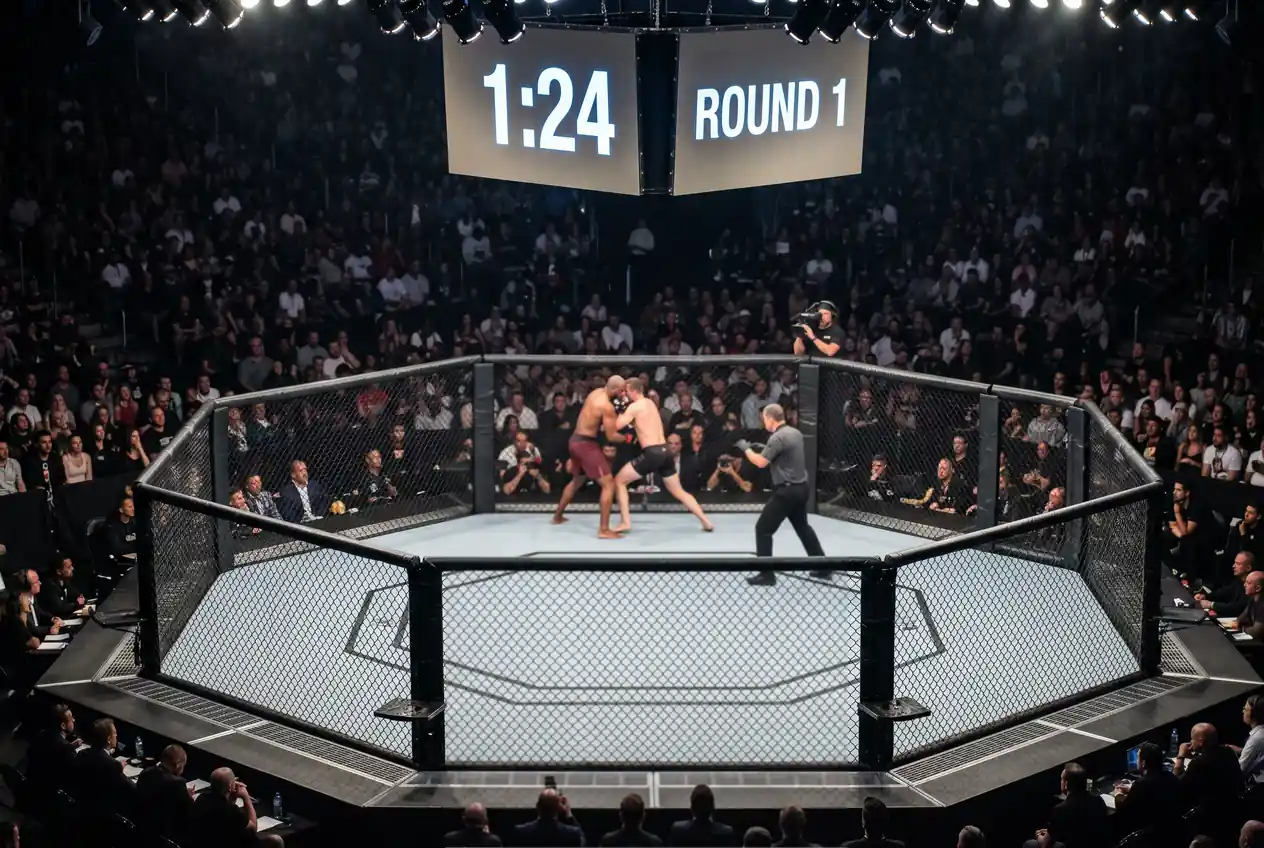
The octagon is the eight-sided enclosed fighting area where UFC bouts take place. Every UFC fight happens inside the octagon, and the term is used interchangeably with “the cage” in betting contexts. When a sportsbook refers to “octagon odds,” they mean UFC fight odds.
A bout is a single fight between two fighters. A card is the full slate of bouts on a given event night. Cards are divided into the prelims (the opening fights, typically featuring less established fighters) and the main card (the featured fights, usually four to five bouts including the main event). Numbered events – like UFC 325 – are the promotion’s marquee shows, while Fight Nights are the more frequent, slightly lower-profile events that fill the calendar.
Method of victory refers to how a fight ends: knockout (KO), technical knockout (TKO), submission, or decision. A KO is when a fighter is rendered unconscious. A TKO is when the referee stops the fight because a fighter can no longer defend themselves intelligently, even if they are still conscious. In betting, KO and TKO are grouped together as a single outcome. A submission occurs when a fighter forces their opponent to “tap out” by applying a chokehold or joint lock. A decision means the fight went the scheduled distance and the outcome was determined by the judges’ scorecards.
Significant strikes are strikes that the UFC’s statistics system deems impactful – thrown with force and landing cleanly. Jabs at range that barely connect are not counted. This metric drives the “significant strikes over/under” prop market and is the primary statistical measure of a fighter’s offensive output.
Takedown defence is the percentage of an opponent’s takedown attempts that a fighter successfully stops. Control time measures how long a fighter maintains dominant ground position. Both metrics appear in fighter stat databases and influence how sportsbooks price method of victory and round-total markets.
A weight cut is the process of rapidly losing weight before the official weigh-in to compete at a lower weight class. Fighters typically cut 10-20 pounds of water weight and regain it before the fight. Failed weight cuts – where a fighter misses the weight limit – can affect betting markets because they result in penalties, altered fight rules, or last-minute cancellations.
Sportsbook and Wagering Terminology
The moneyline is the simplest bet: pick who wins the fight. Decimal odds of 2.50 mean a £10 bet returns £25 (£15 profit). Fractional odds of 3/2 express the same thing: £3 profit for every £2 staked. American odds use positive and negative numbers – +150 means £150 profit on a £100 stake, while -200 means you must stake £200 to win £100. The global online gambling market surpassed $121 billion in 2025, and the moneyline is the most widely bet market across all of it.
Implied probability converts odds into a percentage representing the market’s estimated chance of an outcome. At decimal odds of 2.00, the implied probability is 50%. The overround (or “vig” or “juice”) is the margin the sportsbook builds into the odds – it is the difference between the total implied probabilities of all outcomes and 100%. An overround of 105% means the sportsbook retains approximately 5% of all money wagered on that market.
A bet builder combines multiple selections from the same fight into a single wager. An accumulator (or “acca” or “parlay”) combines selections from different fights. The key difference is that bet builders involve correlated outcomes within one bout, while accumulators involve independent outcomes across separate bouts.
Cash out allows you to settle a bet before the fight ends, locking in a profit or limiting a loss based on the current live odds. Partial cash out lets you settle a portion of the bet while leaving the rest active. In-play betting (or live betting) means placing bets after the fight has started, with odds updating in real time between exchanges and between rounds.
Enhanced odds (or “odds boosts” or “price boosts”) are temporary promotional increases in the price offered on a specific selection. Free bets are promotional tokens that let you place a bet without using your own money, though most are “stake not returned” – meaning if you win, you receive the profit but not the free bet amount itself. Approximately 290 million online bets on real events are placed monthly across the UK, many of them using these promotional tools.
UK-Specific Terms: Accumulator, Punter, and More
The UK betting vocabulary has its own flavour, and some terms that are obvious to experienced punters can confuse newcomers or readers from other markets.
A punter is a bettor. The term is used casually across UK sportsbooks, media, and conversation. A bookie (or bookmaker) is the sportsbook or betting operator. In the UK, “bookmaker” carries no negative connotation – it is simply the standard term for a licensed betting company.
An accumulator (acca) is the UK term for a parlay – a multi-selection bet where all legs must win. “I put a four-fold acca on the main card” means “I bet a four-leg parlay across four fights.” Acca boosts are percentage increases applied to accumulator winnings, offered as promotions by most UK sportsbooks.
Each-way betting does not apply to UFC – it is a concept from horse racing. If you see the term in a UFC context, it has been misused. Similarly, “yankee,” “heinz,” and other traditional UK bet types refer to specific combinations of accumulators and are rarely applied to UFC markets.
GGY – gross gambling yield – is the industry’s measure of revenue: total money wagered minus winnings paid out. When you read that the UK gambling industry generated £15.6 billion in GGY, that figure represents the total retained by operators after paying out winners. UKGC – the UK Gambling Commission – is the regulatory body that licenses and oversees all legal gambling in Great Britain.
Understanding these terms is not just about comprehension – it is about confidence. When you can read a sportsbook’s UFC page, a betting analysis article, or a community discussion and understand every term without pausing, you are operating at the level where genuine analysis begins. The vocabulary is the gateway; the analysis that follows is where the value lives.
What is the difference between a parlay and an accumulator in UFC betting?
They are the same thing. Parlay is the term used in North America, while accumulator (or acca) is the standard UK term. Both refer to a multi-selection bet where all legs must win for the bet to pay out. The odds of each leg are multiplied together to produce the combined price.
What does moneyline mean in UFC betting?
The moneyline is the simplest UFC bet: you pick which fighter wins the bout. No need to predict how or when the fight ends – if your fighter wins by any method in any round, the bet pays out. The moneyline is the most commonly bet market in UFC.
What are significant strikes in UFC statistics?
Significant strikes are strikes deemed impactful by the UFC’s official statistics system – thrown with force and landing cleanly on the opponent. They exclude light touches and glancing blows. The significant strikes count drives the over/under prop market and is the primary measure of a fighter’s offensive output in statistical analysis.
Prepared by the ufc Betting Website editorial staff.